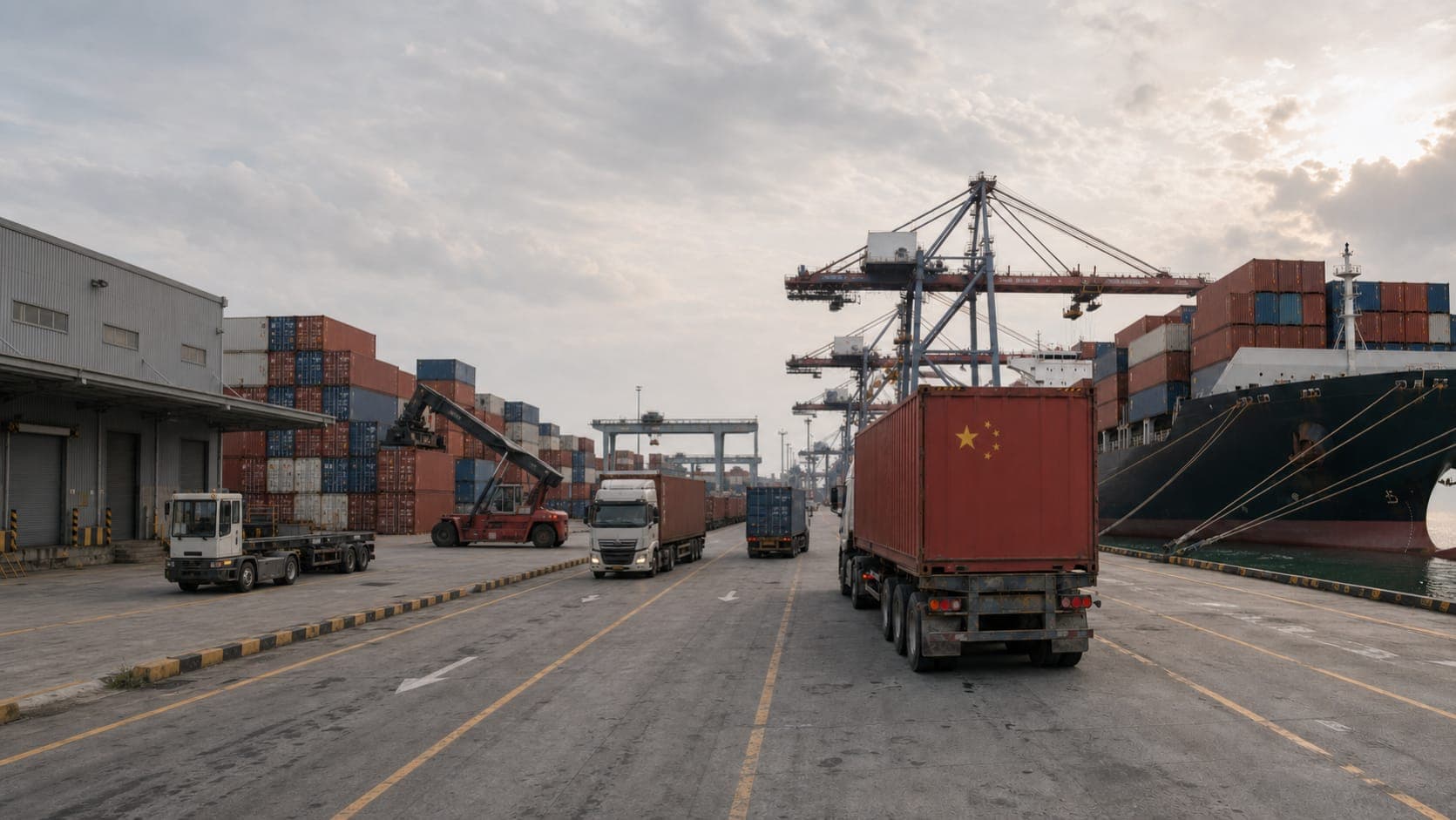
EU Summit on China: Quotas for Chemicals and Machinery, Textiles Not Affected for Now
At the EU summit in Brussels, all 27 member states are calling for import quotas against Chinese chemicals and industrial machinery. Clothing is not on the list. What this means for your imports.
Request a quoteOne week after the agreement in Beijing, the EU heads of state and government met in Brussels to discuss China. We summarised what was agreed in Beijing in our article on the EU-China agreement. The question now is how hard the EU will push further. The first answer from the summit: chemicals and machinery are in the sights, not clothing. This article is current as of the morning of 16 October 2026; the second day of the summit is still under way.
What the EU summit discussed on China
On 15 October, China was the subject of a working lunch with Commission President Ursula von der Leyen. According to an EU diplomat, all 27 member states urged the Commission to examine import quotas to protect the chemical industry and industrial machinery (Euronews, 15.10.2026). A senior EU official also announced that the Commission intends to present two new tools by the end of the year: an instrument for diversifying supply chains and a solidarity mechanism for member states hit by Chinese countermeasures.
According to the draft summit declaration, the heads of state and government are to call on the Commission to continue the dialogue with Beijing, make full use of the existing trade defence instruments and add new ones (Reuters via TimesLIVE, 15.10.2026). The texts mostly speak of "macroeconomic imbalances"; China is often not named.
The pressure has mainly come from Germany and France. Their joint proposals from the week before the summit call for quick action against imports of chemical products and PET plastic and a faster response to countries that harm the single market. According to Reuters, an investigation into PET is to start soon.
New details on the hybrid car agreement
On the day of the summit, Euronews reported new details of the Beijing agreement. It provides for country-specific quotas for Chinese hybrid cars: 350,000 vehicles per year over four years, with a fixed annual adjustment of 6 per cent. In return, China will ease export licences for rare earths and lower duties on EU car parts, olive oil and shoes.
A comparison helps with scale: according to Euronews, Chinese car exports to the EU are worth around 15 billion euros. The EU trade deficit with China stood at 360 billion euros in 2025, and Chinese exports to the EU rose by about 25 per cent last year. The hybrid agreement alone does little to change this imbalance. That explains why member states are now bringing further sectors into play.
Why textiles remain in view
Textiles and clothing do not appear in any of the summit reports we reviewed. For your imports, that means there is no announced quota and no new duty on clothing from China. The regular EU rates apply, for example 12 per cent for a cotton T-shirt under HS code 6109 10 (zolltarifnummer.com, updated 16.07.2026).
Textiles are not entirely out of the picture, however. Denis Redonnet, the Commission's chief trade enforcement officer, expressly named them on 1 October before the European Parliament's trade committee among the sectors with "persistent and abnormal import growth", alongside machinery, base metals and chemicals (FashionNetwork, 01.10.2026). Chemicals and machinery from this list are now moving into focus. Textiles are the part of the list for which nothing has been announced so far.
There is also pressure from the industry itself. The European textile association Euratex is calling for tighter customs controls, faster use of trade defence instruments and a handling fee of around 10 euros per small parcel. According to the association, about a third of the textile and clothing products sold in Europe come from China (Textalks, 19.09.2026). The parcel fee targets online retail with single shipments, not B2B imports in cartons or containers.
What this means for importers
Nothing changes for current orders and those planned for the short term. In the medium term, the risk rises that the EU will examine further sectors after chemicals and machinery. If you are planning larger volumes for 2027, you should factor this in:
- Check contract clauses: Clarify who bears additional duties if a new measure takes effect between order and customs clearance. With a DDP delivery, the duty risk initially lies with the supplier, so the rule should be stated in the quotation.
- Record your tariff codes: New measures are defined by HS codes. If you know your codes, you can see immediately whether you are affected.
- Fix orders early, before Chinese New Year on 6 February 2027. Many factories pause for several weeks around the holiday, and bottlenecks and political uncertainty would then coincide.
The next dates: the Commission wants to present its new instruments by the end of the year, Šefčovič and China's trade minister Wang Wentao will confer by video conference in January 2027, and the third round of negotiations follows in March. Once the final conclusions of the summit are published, we will update this article.
At DS Trading, we include duty and import VAT in the quotation based on the HS code of your item, see Services. If you want to know how a specific order would be affected by possible changes, write to us via the contact page.
Frequently asked questions
Is the EU planning import quotas for textiles from China?
Not so far. At the EU summit on 15 October 2026, member states called for quotas on chemical products and industrial machinery. Textiles were not mentioned in the reports on it.
What did the EU summit decide on China in October 2026?
The heads of state and government are urging the Commission to continue the dialogue with China, make full use of trade defence instruments and develop new ones. Concrete quotas are to be examined first for chemicals and machinery.
Does the proposed parcel fee also apply to B2B imports?
The Euratex proposal targets low-value small shipments, so mainly online retail with single parcels. It is not intended for goods imports in cartons or containers.
Sources
- EU summit: Costa takes charge of budget talks as leaders stick to red linesEuronews · 15.10.2026 · accessed 16.10.2026
- EU leaders to tackle Chinese exports, energy prices, budget at summitReuters / TimesLIVE · 15.10.2026 · accessed 16.10.2026
- China driving worrying rise in EU imports, Commission official saysFashionNetwork · 01.10.2026 · accessed 16.10.2026
- Europe’s textile industry demands faster action as China trade pressure deepensTextalks · 19.09.2026 · accessed 16.10.2026
- Zoll China & Zolltarifnummer China 2026zolltarifnummer.com · aktualisiert 16.07.2026 · accessed 16.10.2026
Ready for your quote?
Send us your product and target quantity. We reply within 48 hours with a quote including landed cost and lead time.
Request a quote