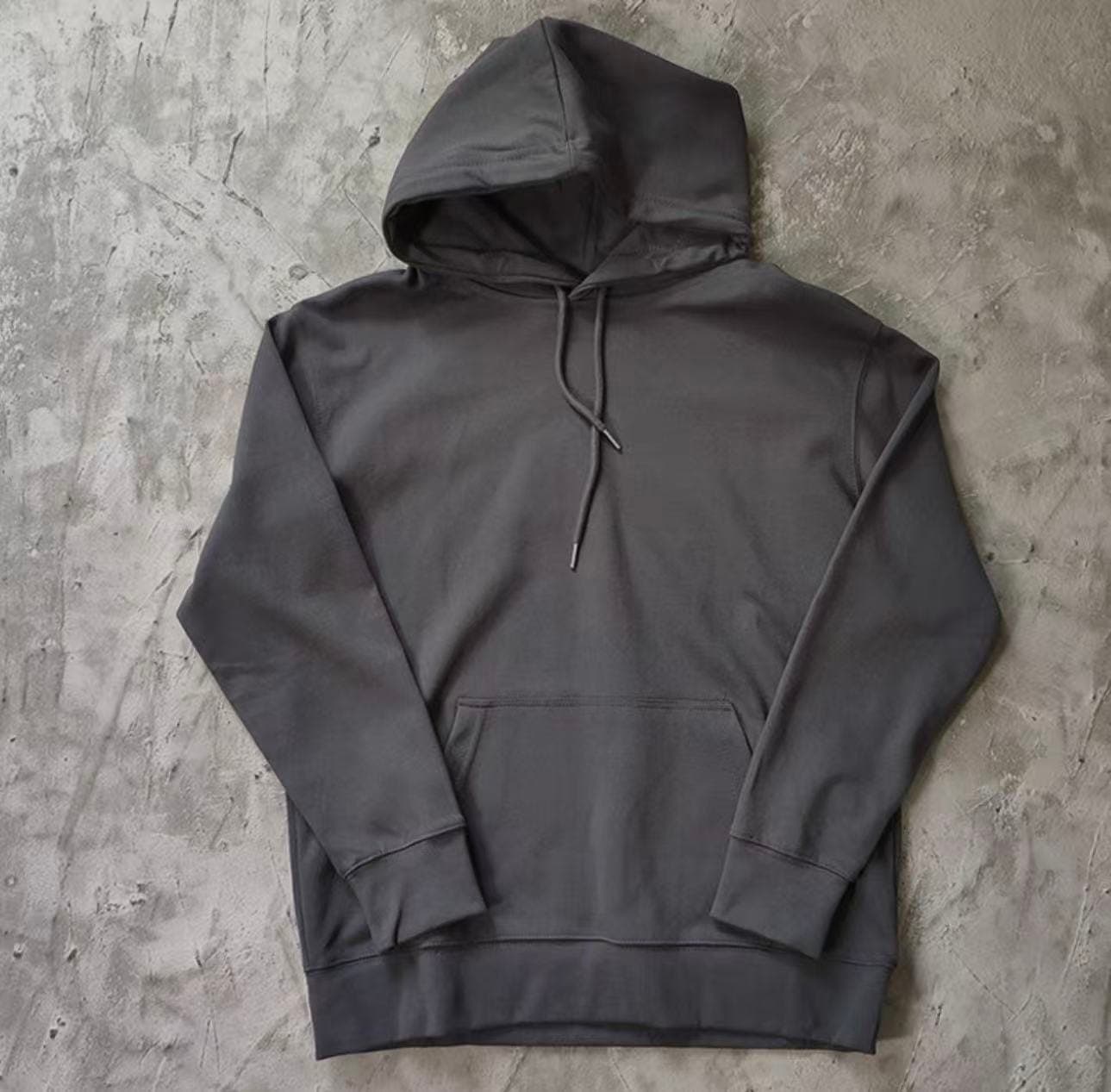
Having Hoodies Made: Fabric, GSM, Fit, Finishing and Process
Fabric, weight, construction, size chart, finishing, sampling, inspection and packaging: the full process for hoodies made in China.
Request a quoteIf you want hoodies made in China, the main decisions are fabric, weight, cut and finishing. Two hoodies that look the same in a photo can differ a lot in handfeel, warmth, shrinkage and durability. This guide follows the order in which these points come up in a project, from the fabric through sampling and production to packaging.
Which fabric works for a hoodie?
Most hoodies are made from French terry or brushed fleece. French terry has small loops on the inside, feels a little lighter and is comfortable when temperatures change. With fleece, those loops are brushed open, which makes the inside soft and fluffy and keeps it warmer.
For fibre, 100% cotton is the classic choice for brand hoodies. Blends with polyester, for example 80% cotton and 20% polyester, shrink less and dry faster, but they are more likely to pill on the inside. Sports zip jackets often use French terry with a higher polyester share, such as 75% polyester and 25% cotton. Some hoodie factories also offer fabrics knitted from two-ply yarn, which are firmer and keep their shape better.
Screen print and embroidery work best on a smooth, dense cotton face. If you already know how you want to decorate the hoodie, say so when you choose the fabric.
What fabric weight is right?
Hoodie fabric usually weighs between 280 and 350 g/m². Heavyweight streetwear hoodies go up to about 400 g/m². The right value depends on how the hoodie will be used, the cut and your budget.
- Around 280 to 300 g/m²: a lighter hoodie for merch, events and teamwear, good for indoors
- Around 320 to 350 g/m²: mid to heavy weight, a common choice for private label and brands
- Above 350 up to about 400 g/m²: heavyweight, stiff and voluminous, suits oversized and boxy cuts
Many factories work with fixed fabric weights from their own stock, for example 300 or 340 g/m². A value in between, such as 320 g/m², then needs specially knitted fabric, which costs time and volume. So we ask early which qualities the producer holds and suggest the closest weight. The figure always refers to the finished, dyed fabric. The tech pack states a target value with a tolerance.
Which construction details belong in the specification?
A hoodie has more parts than a T-shirt, and any of them can turn out differently from what you had in mind. Settle these points before the sample:
- Hood: two- or three-panel, single or double layer, height and width in cm
- Drawcord: round or flat, length, metal or plastic tips, embroidered or metal eyelets, or no drawcord at all
- Shoulder: set-in sleeve for a regular fit or dropped shoulder for oversized
- Cuffs and hem: 1x1 or 2x2 rib with elastane, height in cm
- Pocket: kangaroo pocket, zipped side pockets or none
- Zip hoodies: type, material and colour of the zip, and whether it runs up into the hood
With heavy fabrics, a double-layer hood pays off because it holds its shape and looks clean inside. Cuffs without elastane often lose their tension after a few washes. Specify colour and finish for metal parts such as eyelets, cord tips and zips so the factory does not switch to something similar.
How do you define the fit and size chart?
With a measurement chart that gives values at fixed measuring points for every size. Words like regular, oversized or boxy only point in a direction. The usual points are half chest, total length from the high point of the shoulder, shoulder width, sleeve length, hem width, cuff height, and hood height and width.
Chinese factories often start from Asian base measurements, which run shorter and narrower. We therefore provide a European size chart, from S to 5XL if needed. A women’s cut has its own measurements and is not a scaled-down men’s size. The largest sizes use more fabric and often cost a little more. Each measuring point gets a tolerance in the chart, usually one to two centimetres for chest and length.
Cotton fleece can shrink in the first wash. Ask whether the fabric is pre-shrunk, and wash the sample once according to the care label. If you measure again afterwards, you will know before production whether the measurements hold.
Print, embroidery and labels on hoodies
Screen print, puff print with a raised effect, heat transfer and embroidery are the usual methods for hoodies. Flat embroidery looks premium on heavy fleece. 3D embroidery needs the right machine and an embroidery shop that does it regularly. For a new logo, we recommend starting with flat embroidery and moving to 3D only if the design suits it.
Embroidery on thick fabric can pucker if the backing or stitch density is wrong. Print on fleece needs a smooth face and an ink that suits the fabric. That is why every decoration is checked on the real fabric in the sample, with position, size in cm and a Pantone reference.
Send print and embroidery files as vector files (AI, EPS, PDF or SVG) and also as a high-resolution image with the measurements marked. Vector files do not always arrive in a readable state through Chinese messaging apps, so we check that the producer can open the file before the sample starts.
Branding usually covers a woven or printed neck label, a care label and a hangtag, sometimes a hem label or a silicone badge as well. Many factories price the care label and hangtag separately from the garment. We therefore put both into the specification from the start, so that no extra charge turns up later.
The care label must state the fibre composition correctly under EU law. We compare the label file with the fabric specification before production. The article on textile labelling for imports explains what has to be on the label.
How does sampling work?
Every production run starts with a physical sample, which is always charged, and so is its shipping. You know the cost beforehand. At a factory that knows the product, a hoodie sample is often ready in one to two weeks. Custom embroidery, special fabric or your own colour take longer.
Take your time with the sample: wear it, compare the measurements with the chart, wash it once and look closely at the embroidery and print. Changes go into the next version of the tech pack. Production starts only after your written approval. The steps are described on the sampling page.
Colour has one quirk. Hoodie fabric and T-shirt jersey are dyed separately. If you plan a hoodie and a T-shirt in the same shade, smaller quantities often only get you close shades, because no stock fabric exists in exactly the same colour. We then get a colour card from the factory and agree the shades with you before the sample.
What does our team check during and after production?
As standard, our own team in China checks twice at the producer: once during production and once on the finished goods before shipment. The reference is the approved sample and the specification. You can waive the inspection, which makes the order cheaper.
- During production: weight and colour of the bulk fabric, the first finished pieces, position and size of print or embroidery
- After production: measurements per size, seams, cuffs, hood and drawcord, decoration, labels, packaging, carton contents and quantity
If our team finds a deviation, we tell you straight away and decide together what happens before the goods leave China. More about the inspection process is on the quality page.
Common hoodie faults and how to prevent them
- Fabric lighter than agreed: put the target weight with a tolerance in the tech pack and have the bulk fabric weighed
- Measurements only right in the sample size: give values for every size and measure several sizes
- Cuffs stretch out: specify rib with elastane
- Hood too flat or uneven: specify hood measurements and construction
- Embroidery puckers: check stitch density and backing on the sample
- Colour differs between two dye lots: use the Pantone reference and approved sample as the standard, and the same fabric for reorders where possible
- Care label missing or misstating the fibre content: check the label file before production starts
- Trims swapped without asking, such as eyelets or a zip in a different shade: state in the tech pack that every deviation needs approval
Packaging and shipping
The usual packing is one folded hoodie per polybag with a size sticker. Whether the bag carries a suffocation warning and whether you need a barcode for online retail is agreed before production.
Each carton needs a shipping mark with order number, article, colour, size split, quantity, gross and net weight and carton dimensions. The packing list and carton marks have to match, otherwise customs and goods-in will have questions. For traceability under the EU General Product Safety Regulation, an article or batch number should appear on the label and the carton.
Hoodies are heavy and bulky, so sea freight is especially worthwhile. Sea freight DDP takes 50 to 65 days, air freight about 15 days and express usually around 5 days to Germany. Production itself takes between 3 days and 4 weeks depending on the article. We deliver DDP into the EU and DAP to Switzerland, with an invoice from Germany. Which mode fits your date is covered in sea or air freight.
We plan realistic delivery dates and do everything we can to meet them. Around Chinese New Year there can be delays, so allow some buffer. Tips are in the article on Chinese New Year.
What should your enquiry include?
- A photo, sketch or reference hoodie, ideally with a note on what should be different
- Fabric and target weight, for example 100% cotton French terry at around 340 g/m²
- Colours with Pantone references and the quantity per colour
- Size range and size split, with your own measurement chart if you have one
- Decoration with file, position and size in cm
- Labels, hangtag and packaging
- Delivery address, target date and whether sea or air freight is an option
A finished tech pack helps but is not a requirement. If you do not have one, we go through the points with you on a call. The article on tech packs for clothing explains what one contains. For very small quantities we cannot do it; ask anyway, and we will tell you honestly whether it is worth it.
You get a reply within 48 hours. Your European contact stays the same from the first call to delivery. How we choose the right producer is explained on the hoodie manufacturer China page.
Frequently asked questions
Is a heavy hoodie automatically better quality?
No. A high fabric weight has to suit the fibre, cut, cuffs and use. A 400 g hoodie in a regular fit can feel stiff, while a well-made 320 g/m² hoodie may fit better.
How long does it take to have hoodies made in China?
The sample usually takes one to two weeks and production 3 days to 4 weeks, depending on the article. Shipping comes on top: sea freight DDP 50 to 65 days, air freight about 15 days, express usually around 5 days.
Can I get a hoodie and a T-shirt in exactly the same colour?
Not always. The two fabrics are dyed separately, and for smaller quantities there is often no stock fabric in the identical shade. We agree the colours in advance using a colour card and show you the result on the sample.
Can a hoodie be embroidered to my design?
Yes. Flat embroidery, 3D embroidery and print are all possible. File, position, size and colours are specified and approved on the sample before production starts.
Are reorders checked against the first sample?
Yes. The approved sample and the documented specification remain the reference for every follow-up order.
Sources
- Verordnung (EU) Nr. 1007/2011 über Textilfaserbezeichnungen und KennzeichnungEuropäische Union · konsolidierte Fassung · accessed 24.08.2026
- Verordnung (EU) 2023/988 über die allgemeine ProduktsicherheitEuropäische Union · 10.05.2023 · accessed 24.08.2026
Ready for your quote?
Send us your product and target quantity. We reply within 48 hours with a quote including landed cost and lead time.
Request a quote