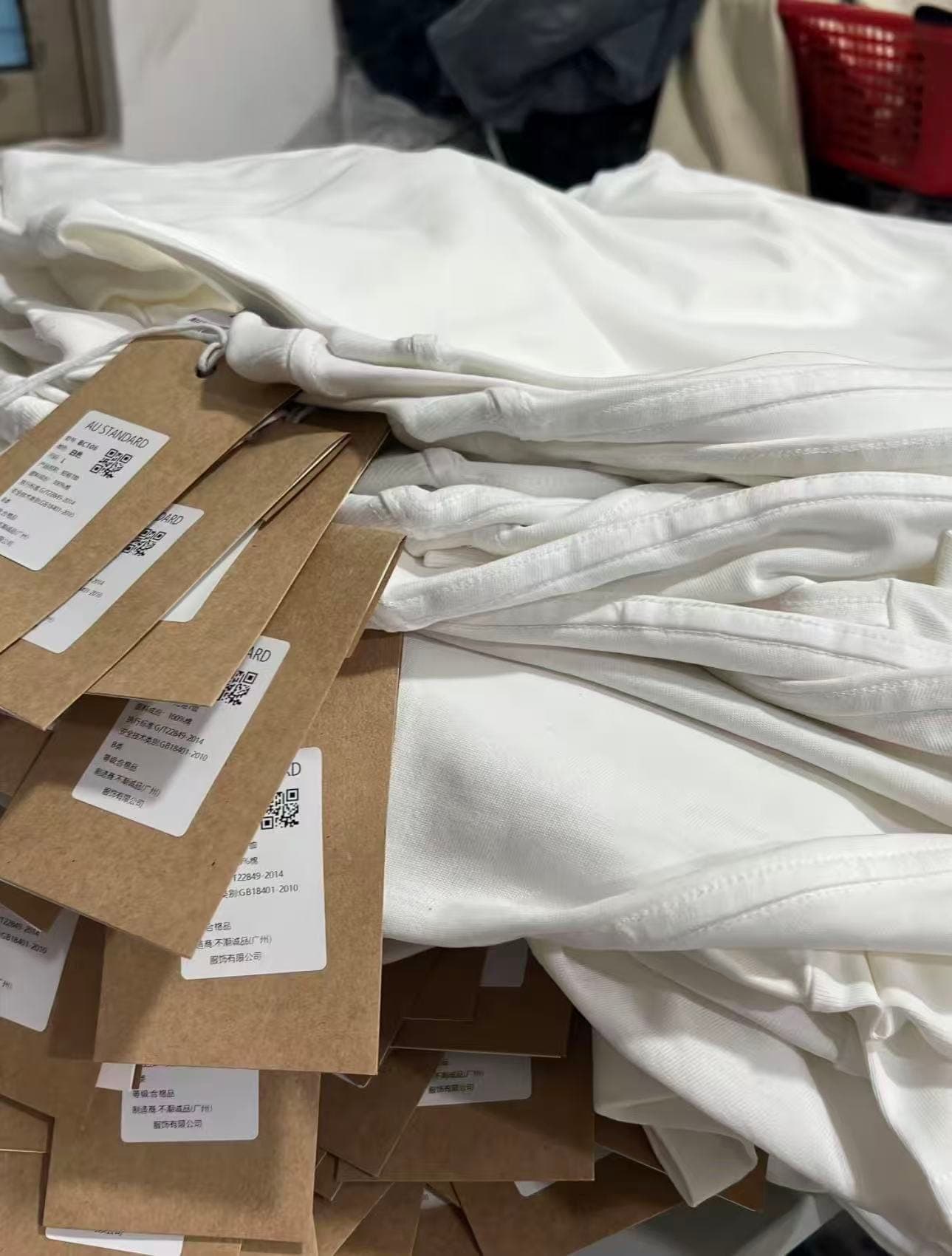
Textile Labelling on Import: Labels and Obligations
Which details belong on the label of imported clothing, which are voluntary, and how to brief the label file so the producer gets it right.
Request a quoteThe small label in the side seam has more work to do on import than it seems. Some details are required by textile law, others come from product safety rules, and some are voluntary. This guide sorts out the obligations for clothing made in China and sold to consumers in the EU. It also shows what you should give the producer as a brief. It is meant as orientation and is not legal advice for an individual case.
Which details are mandatory on a textile label?
The fibre composition is mandatory. Regulation (EU) No 1007/2011 requires textile products to be labelled or marked accordingly whenever they are made available on the EU market. A product that is at least 80 % textile fibre by weight also counts as a textile product. Between businesses in the supply chain, commercial documents can replace the label. As soon as the goods go to consumers, the information has to be on the product.
The labelling must be durable, easily legible, visible and accessible, and a label must be securely attached. In practice this means a sewn-in label that stays readable after many washes. A hang tag on its own does not meet this, because it is cut off after purchase. On a combined label, the fibre information has to be clearly separated from other information such as care instructions.
Which fibre names are allowed?
Only the fibre names listed in Annex I of the Regulation are allowed, for example cotton, polyester, polyamide, elastane, viscose or wool. Write the names out in full; the Regulation only allows abbreviations such as CO or PES in narrow exceptions. Trade names like Lycra or Tencel do not replace the fibre name. They may, however, appear immediately before or after the fibre composition.
“100 %”, blends and tolerances
Terms such as “100 %”, “pure” or “all” may only be used for products made exclusively of one fibre. A technically unavoidable share of other fibres of up to 2 % is permitted. For blends, list all fibres with their percentage by weight in descending order, for example “60 % cotton, 40 % polyester”. Between the stated percentages and the result of a laboratory analysis, the Regulation allows a manufacturing tolerance of 3 %.
Several components and parts of animal origin
If a garment consists of several textile components with different compositions, each component needs its own declaration, for example the outer fabric and the lining of a jacket. Components below 30 % of the total weight do not have to be stated, but a main lining always does. If the product has non-textile parts of animal origin, such as a leather patch on jeans or a cap, the label must say “Contains non-textile parts of animal origin”.
Which language does the label have to be in?
In the official language of the Member State where the goods are sold to consumers, unless that state provides otherwise. For Germany and Austria, that means German. In countries with several official languages, such as Belgium, check beforehand which languages are required there. The EU Regulation does not apply in Switzerland, where Swiss rules are decisive.
If you supply several markets, you will usually print multilingual labels. This saves separate labels for each country but makes the label much longer. A care label with five or six languages often needs several panels that are folded and sewn in as a strip. Plan the size and material early so the label does not irritate the skin.
The fibre composition must also be clearly visible before purchase when buying online. Your shop therefore needs the same composition as the label, for every colour and every fabric variant.
Are care symbols mandatory?
Not in Germany. The law requires the fibre composition; care labelling is voluntary. Most garments still carry a care label, because customers ask for it and wrong instructions lead to complaints. If you do give care instructions, they should match the actual product. A printed or embroidered garment often tolerates less heat when ironed than the plain fabric.
The familiar symbols for washing, bleaching, drying, ironing and professional cleaning are standardised in ISO 3758 and protected as trademarks. Their owner, GINETEX, requires a licence through its national member organisation for their use (Onlinehändler News, 3 July 2026, in German). Clarify this before you have labels with symbols printed. Care instructions in plain text, such as “Machine wash 30 °C, do not iron”, are an alternative.
Does “Made in China” have to be on the label?
There is no general EU obligation to state the country of origin on clothing. If you do state an origin, it has to be correct. A shirt sewn in China that says “Made in Germany”, or carries a flag suggesting a different origin, misleads customers and can draw a legal warning under German unfair competition law. Some brands still print “Made in China”, for instance because trading partners ask for it or because goods later go to countries such as the USA that require an origin mark.
What does the General Product Safety Regulation (GPSR) require?
Regulation (EU) 2023/988 on general product safety has applied since 13 December 2024. It also covers clothing and requires information that links a product to the parties responsible for it:
- a type, batch or serial number or another element that allows the product to be identified
- the manufacturer’s name, registered trade name or registered trademark, plus postal and email address
- for goods from outside the EU, also the importer’s name, trade name or trademark and address
- safety information in a language consumers in the country of sale can easily understand, where such information is needed
This information belongs on the product itself. Only where that is not possible may it go on the packaging or in an accompanying document. On a T-shirt, the sewn-in label is the obvious place, and a batch number can be added there as a separate line.
One point matters especially for private label brands. Anyone who markets goods under their own name or brand counts as the manufacturer under the GPSR, even if a producer in China sewed them. For products placed on the EU market, there must also be a responsible economic operator established in the EU. Clarify who that is for your goods before the label file goes to the producer. In an online shop, the listing must also show the manufacturer details, the responsible person in the EU where applicable, a product image and the product identifier.
Where are the labels sewn in?
The brand label usually sits at the neck, either as a woven label in the neck seam or printed directly onto the fabric. The label with fibre composition and care instructions is usually sewn into the lower part of the left side seam. Small brand details such as a loop on the sleeve or a woven tab in the hem are design elements and carry no mandatory information.
A printed neck label without a fabric tag is more comfortable to wear. Even then, the mandatory information has to be durable and survive many washes. With tear-away labels that can be pulled out, the fibre composition belongs on a second, permanent label, because the tear-away part does not stay on the garment.
Clarify early how labels are handled in the quote. Many producers do not automatically include woven labels, care labels and hang tags in the unit price. Custom labels often also involve one-off costs for a weaving template or a printing plate.
What belongs in the specification for the producer?
Mistakes in the label file are often only noticed on the finished garment. Then labels have to be woven or printed again and sewn in again, and the delivery date moves. So give the producer a finished file that you have checked yourself:
- fibre composition for each component using the names from Annex I, in every language required
- care instructions as symbols or text, matched to the fabric and the decoration
- name, postal and email address of the manufacturer and, where applicable, the importer
- article or batch number for traceability
- size and, if wanted, the country of origin
- material, dimensions and print method of the label
- position and attachment of every label, ideally with a photo or sketch
Watch out for special characters. German umlauts and the ß are easily mangled in print files, and the label ends up reading “StraBe” instead of “Straße”. Send the file as a PDF with embedded fonts and ask to see a photo of the finished label before production. The label file belongs on its own page in the tech pack. If you do not have a tech pack yet, we are happy to go through the details with you on a call.
What does our team check on site?
During the two checks, during and after production, our team in China compares the labels with the approved label file and the approved sample. We check that every label sits in the agreed position, that texts and languages are complete and that the size label matches the actual size. If something is off, we get in touch with you on our own and sort out the correction before the goods are shipped.
There are two questions an on-site check cannot answer. Whether the stated composition is really what is in the fabric can only be shown by a laboratory analysis. Whether your labelling is legally complete is your responsibility as the party placing the goods on the market, with specialist advice if in doubt. Voluntary certificates such as OEKO-TEX and GOTS do not replace any of these obligations.
How the checks work is described on our quality control page. The checkpoints of the final inspection, labels included, are explained in our guide to pre-shipment inspection. The whole route to your own collection is covered under importing private label clothing.
Frequently asked questions
Does the fibre composition have to appear in my online shop?
Yes. Consumers must be able to see it clearly before purchase, including when buying online. The information in the shop should match the label.
Are care symbols on clothing mandatory?
Not in Germany. The symbols are protected as trademarks, though, and GINETEX requires a licence for their use. Care instructions in plain text are an alternative.
Does “Made in China” have to be on the label?
There is no general EU obligation. If you state an origin, it has to be accurate and must not mislead customers.
Is a hang tag enough for the fibre composition?
No. The fibre composition has to stay on the product permanently, and a hang tag is removed after purchase. It works well for additional information such as a barcode or brand message.
Does the on-site check verify the actual fibre composition?
No. Our team checks that the correct label is complete and in the agreed position. The actual composition of the fabric can only be determined in a laboratory.
Sources
- Verordnung (EU) Nr. 1007/2011 über Textilfaserbezeichnungen und KennzeichnungEuropäische Union · konsolidierte Fassung · accessed 24.08.2026
- Verordnung (EU) 2023/988 über die allgemeine ProduktsicherheitEuropäische Union · 10.05.2023 · accessed 24.08.2026
- Textile labelYour Europe, Europäische Union · laufend aktualisiert · accessed 31.10.2026
- Pflegesymbole auf Textilien: Vorsicht, Abmahnfalle!Onlinehändler News (Händlerbund) · 03.07.2026 · accessed 31.10.2026
Ready for your quote?
Send us your product and target quantity. We reply within 48 hours with a quote including landed cost and lead time.
Request a quote