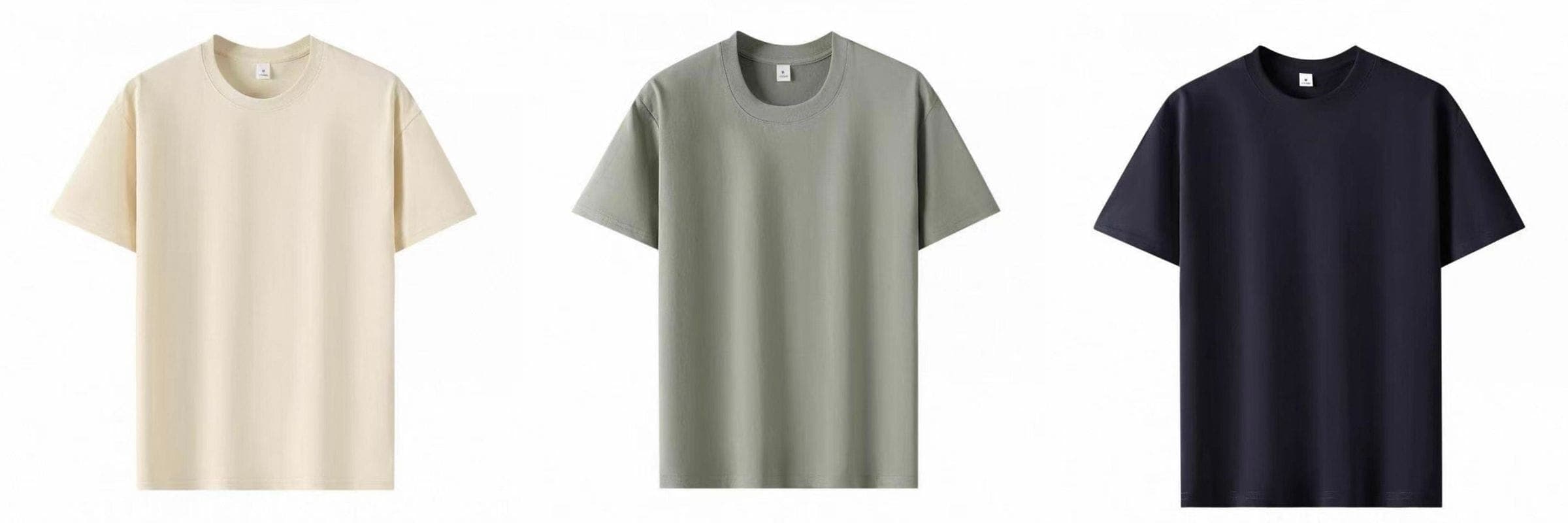
Having T-Shirts Made: Fabric, GSM, Cut, Print and Process
Jersey, fabric weight, collar, size chart, print, labels, sampling, inspection and packaging: what to define for T-shirts made in China.
Request a quoteA T-shirt looks like the simplest garment there is, which is exactly why quotes for it can be so far apart. Fibre, yarn, knit, weight, cut, collar and decoration decide how the shirt feels, how it looks after many washes and what it costs. This article covers what to define before you have T-shirts made in China, and how sampling, inspection and shipping work.
Which fabric suits which T-shirt?
Most T-shirts are knitted from single jersey, smooth on the outside with small loops on the inside. Interlock is smooth on both sides, denser and a little heavier. It is used for babywear, for example, or for shirts that need to hold their shape well. Rib is mainly used for the collar.
- 100% combed, ring-spun cotton: soft, even surface, prints well, the usual choice for brand T-shirts
- 100% carded cotton: cheaper and slightly rougher, often used for promotional and event shirts
- Cotton with about 5% elastane: more stretch and recovery, for close-fitting cuts and raglan shirts
- 100% polyester: for sportswear and jerseys, and the basis for sublimation printing
- Organic cotton: usually knitted in larger fabric quantities, so smaller runs often have to use existing stock fabric
What GSM is right for a T-shirt?
A standard basic is usually 160 to 190 g/m², a heavyweight shirt 220 to 260 g/m². The weight tells you how much one square metre of the finished fabric weighs. Across all T-shirts, the range runs from about 140 to 260 g/m².
- 140 to 160 g/m²: light and summery, typical for promotional shirts and jerseys
- 170 to 200 g/m²: the middle ground for basics, merch and private label
- 220 to 260 g/m²: heavyweight with a firm handfeel, stands away from the body and suits oversized cuts
More weight does not automatically mean more quality. A heavy fabric drapes differently, wears warmer and needs a cut that suits it. If a factory recommends a lighter weight than you asked for, it is worth holding both fabrics as swatches before you decide.
T-shirt factories like to work with fabric from their own stock. Stock fabrics in standard colours are available faster and are often cheaper than fabric dyed to order. A custom colour means dyeing the fabric, which only pays off above a certain fabric quantity. For blanks in standard colours, a quote is therefore usually quicker than for a special colour.
Construction: collar, seams and sleeves
- Collar: crew or V-neck, rib usually 1x1 with a little elastane, width in mm
- Neck tape: a shoulder-to-shoulder tape covers the seam and stabilises the collar
- Body: tubular without side seams, or with side seams
- Sleeves: set-in, raglan or dropped shoulder for oversized
- Hems: sleeves and bottom hem usually twin-needle stitched
Special details should go into the tech pack with a photo. On ringer shirts, the collar and sleeve bands are in a contrast colour. There are two ways to make striped shirts: the stripes are knitted in with dyed yarn, or they are printed onto white fabric. Knitted-in stripes cost noticeably more, but they also look clean on the inside and at the seams.
Washes such as acid wash, garment dye or enzyme wash change the colour, handfeel and measurements. A very strong acid-wash effect is not available from every producer; a milder garment wash is often offered instead. Because the shirt shrinks once during the wash, the pattern has to allow for it. Always judge the effect on the sample.
Fit, length and size chart
Regular fit, oversized and slim fit mean something different at every factory. A measurement chart makes it clear: half chest, length from the high point of the shoulder, shoulder width, sleeve length, sleeve opening and collar width, each with a value per size.
Asian base patterns often run shorter than is usual in Europe. If you want a men’s shirt that safely covers the belt, specify the length for each size. Women’s cuts have their own measurements. Sizes up to 5XL are possible; the largest often carry a small surcharge because they use more fabric. A tolerance of one to two centimetres is common for chest and length.
Plan the size split per colour early. It decides how many pieces of each size are cut, and it cannot be changed once cutting has started.
Which print method suits your design?
That depends on the number of colours, the size of the design, the fabric and the quantity. An overview of the common methods:
- Screen print: strong, opaque colours, one screen per colour, worthwhile for larger quantities
- Puff print: raised effect for logos and lettering
- Direct-to-garment (DTG): photographic designs with many gradients
- Transfer (DTF or heat transfer): small multicolour designs and sleeve prints
- Sublimation: only on light polyester, the ink goes into the fibre
- Embroidery: small chest logos, with good backing on lightweight jersey
One-off costs arise for screens, embroidery programmes or plates for printed labels. Some producers credit these costs against the production order once the sample is approved. Either way, they belong visibly in the quote.
Send artwork as a vector file and also as a view with measurements in cm. The position is measured from a fixed point, for example 8 cm below the collar seam. Also decide whether the design stays the same size across all sizes or grows with them. Vector files do not always arrive readable through Chinese messaging apps, so we check in advance that the producer can open the file.
Labels and labelling
There are three usual options for the neck label: woven, printed straight onto the neck, or a tear-away label for retailers who sew in their own. Add a care label, a hangtag and, if needed, a sleeve loop. Many factories do not include the care label and hangtag in the garment price, so we ask for them explicitly.
The fibre composition must be stated correctly on the label under the EU Textile Regulation. We check the label file against the fabric specification before production. More in the article on textile labelling for imports.
Sampling and approval
With fabric in stock, a T-shirt sample is often ready in about a week. Fabric dyed to order, knitted-in stripes or washes take longer. The sample and its shipping are charged, and we tell you the cost in advance. Production starts only once you have approved the sample in writing. The process is described on the sampling page.
Check more than the look of the sample. Measure it, wash it once according to the care label and measure again. Watch whether the side seam twists after washing, whether the collar lies flat and whether the print cracks when stretched.
What does our team check on T-shirts?
As standard, our own team in China checks twice, directly at the producer. During production, the focus is the bulk fabric, meaning weight and colour compared with the sample, the first finished shirts and the print position. After production, the team inspects the finished goods before shipment: measurements per size, seams, collar, print or embroidery, labels, folding, bags, carton contents and quantity.
If you waive the inspection, the order gets cheaper. If something deviates, you hear it from us before loading, and we discuss with you how to proceed. Details of the process are on the quality page.
Common T-shirt faults and how to prevent them
- Side seams twist after washing: choose side seams or specify a fabric with low torque
- Collar waves or stretches out: specify rib with elastane and a neck tape
- Fabric lighter than ordered: specify a target weight and tolerance in the tech pack
- Colour differs between dye lots: judge against the Pantone reference and the approved sample
- Print cracks or peels: match the method to the fabric and stretch, and test it on the sample
- Shirt too short or sizes jump unevenly: give measurements for every size
- Fibre content missing or wrong: check the label before production starts
Packaging and shipping
T-shirts are folded, given a size sticker and packed singly or in groups in polybags. Online retail and Amazon FBA usually need individual bags with a barcode. For events, bulk bags are often enough, for example ten shirts of one size per bag. Every carton needs a mark with article, colour, sizes and quantity, and the packing list has to match it.
T-shirts are light, so air freight is more often an option than with hoodies. By sea freight DDP, expect 50 to 65 days to Germany, by air freight about 15 days and by express usually around 5 days. Production itself takes 3 days to 4 weeks depending on the article. Delivery is DDP into the EU and DAP to Switzerland, with an invoice from Germany. When each mode makes sense is covered in sea or air freight. We give you a realistic delivery date and do everything we can to meet it.
What belongs in the enquiry?
- Reference shirt, photo or sketch
- Fabric, fibre and target weight, for example combed cotton single jersey at around 180 g/m²
- Cut and measurement chart, or the length you want per size
- Colours with Pantone references, quantity per colour and size split
- Print or embroidery with file, position and size
- Neck label, care label, hangtag and packaging
- Delivery address and target date
If there is no tech pack yet, we go through the open points together on a call. The article on tech packs for clothing gives an overview. You get a reply within 48 hours, and one European contact looks after your project through to delivery. How we choose the producer is explained on the T-shirt manufacturer China page. If you are planning hoodies too, the details are in the guide having hoodies made.
Frequently asked questions
What GSM is right for a T-shirt?
For a basic, 160 to 190 g/m² is usual; for a heavyweight shirt, 220 to 260 g/m². The right value depends on fibre, cut and use. A higher weight is not automatically the better choice.
Which print method is best for T-shirts?
Screen print for strong colours and larger quantities, DTG for photographic designs, transfer for small multicolour designs and sublimation only on light polyester. The method is chosen per design and checked on the sample.
How long does it take to have T-shirts made in China?
With fabric in stock, the sample is often ready in about a week, and production takes 3 days to 4 weeks depending on the article. For transport, allow 50 to 65 days by sea freight DDP, about 15 days by air freight or usually around 5 days by express.
What is the minimum order quantity?
At DS Trading, the minimum order quantity starts at 300 pieces; the split across variants is clarified per project.
Sources
- Verordnung (EU) Nr. 1007/2011 über Textilfaserbezeichnungen und KennzeichnungEuropäische Union · konsolidierte Fassung · accessed 24.08.2026
Ready for your quote?
Send us your product and target quantity. We reply within 48 hours with a quote including landed cost and lead time.
Request a quote